
 |
|---|

|
From the Gunpowder Plot to Anonymous: How Guy Fawkes Became a Symbol of the Struggle Against Authority
ua.news
November 5, 2026
November 5, 2026, marks the 421st anniversary of the foiling of the Gunpowder Plot—one of the most famous attempts at a coup d’état in British history. In 1605, a group of English Catholics planned to blow up Parliament along with King James I and the country’s political leadership. The plot was foiled, and one of its participants, Guy Fawkes, was arrested near 36 barrels of gunpowder.
Four centuries later, Fox’s name has become famous far beyond the borders of Britain. His stylized face, complete with a thin mustache, goatee, and distinctive smile, can now be seen at anti-government demonstrations, in video messages from hacker groups, and on the symbols of protest movements. The mask gained particular popularity after the release of the film *V for Vendetta* and its adoption by the international hacker collective Anonymous.The reasons behind the Gunpowder Plot are linked to the religious conflicts that shaped English politics throughout the 16th century.
After King Henry VIII broke with Rome, the country gradually established itself as a Protestant state. During the reign of Elizabeth I, Catholics faced severe restrictions: fines were imposed for refusing to attend services of the established church, and Catholic priests were persecuted.
In 1603, James I ascended the English throne. Some Catholics hoped that the new monarch would soften religious policies, but their expectations were not met. The king maintained the Protestant character of the state, which caused discontent among radical Catholics.
One of them was Robert Catesby—a wealthy English Catholic who decided to forcibly change the political order. He was the organizer of the Gunpowder Plot, although Guy Fawkes later became its most famous participant.
Fox was born in 1570 in York. In his youth, he converted to Catholicism and later went to fight on the side of Catholic Spain against the Protestant Netherlands. His military service gave him experience handling weapons and explosives.
In May 1604, Catesby proposed to his associates that they blow up Parliament during the ceremonial opening of the session. Among the first participants were Thomas Winter, John Wright, Thomas Percy, and Guy Fawkes. The plan called for the assassination of the king, members of both houses of Parliament, and a significant portion of England’s political elite.
The conspirators gained access to the cellar beneath the House of Lords, where they brought 36 barrels of gunpowder. The explosives were hidden under firewood and other materials. Fox, who went by the alias John Johnson, was entrusted with carrying out the most dangerous part of the plan.
After the explosion, the conspirators planned to stage an uprising, capture Princess Elizabeth, the daughter of James I, and use her to establish a new political order more favorable to Catholics.
As historians of the British Parliament explain, the conspiracy was the work of a small group of radicals, not all English Catholics.
How the Gunpowder Plot Was Uncovered and Guy Fawkes Was Executed
An anonymous letter prevented the conspirators from carrying out their plan. On October 26, 1605, the Catholic aristocrat William Parker, Lord Montagle, received a warning not to attend the opening of Parliament. The author hinted that a catastrophe would occur during the ceremony but did not provide any details.
The letter was forwarded to the royal authorities. Following this, James I and his advisors ordered a search of the Parliament building. On the night of November 5, authorities discovered Guy Fawkes near the basement of the House of Lords. During a search, they found hidden barrels of gunpowder.
Fox was arrested and taken in for questioning. At first, he refused to reveal the names of his accomplices, but after being tortured, he began to testify. After the plot failed, Catesby and some of his associates fled London. They attempted to organize an uprising but failed to gain widespread support. On November 8, 1605, royal forces caught up with them near the Holbych House estate. Catesby was killed in the ensuing firefight.
Guy Fawkes, along with the other captured conspirators, was tried for treason. On January 31, 1606, he was executed in Westminster.
The failure of the Gunpowder Plot strengthened the position of the royal authority, and restrictions against Catholics were tightened. Fox himself began to be portrayed as a traitor who sought to destroy the monarchy.
Why the British Still Celebrate Guy Fawkes Night
Paradoxically, Guy Fawkes was initially remembered not as a hero, but as an enemy of the state. In January 1606, the English Parliament passed a law designating November 5 as an annual day of thanksgiving for the king’s salvation.
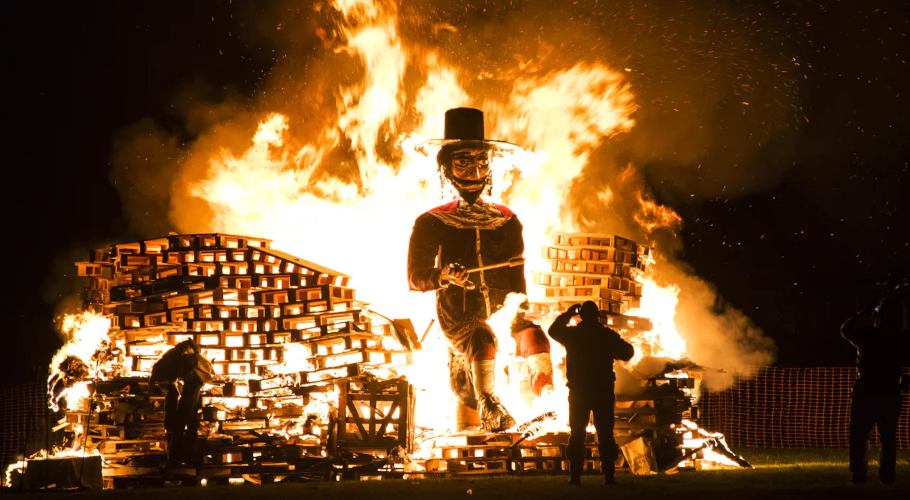
This is how the tradition of Bonfire Night—also known as Guy Fawkes Night—came to be. In towns and villages, people lit bonfires, held celebrations, and burned effigies symbolizing the enemies of the Protestant state. At first, these were often depictions of the Pope, but later Guy Fawkes became the main figure.
In the 19th and 20th centuries, children made effigies of him out of old clothes and went door-to-door asking for money for the festivities. The law mandating the observance of November 5 was repealed in 1859, but the tradition has endured.
Today in Great Britain, people continue to organize fireworks, festive events, and large bonfires. At the same time, modern celebrations have largely lost their original anti-Catholic character.
As the Museum of London explains, over time, the religious and political significance of the event gave way to folk traditions. For several centuries, Fox remained a symbol of treason and a failed attempt to overthrow the government. However, 20th-century popular culture radically transformed his image.
“V for Vendetta”: How the Guy Fawkes Mask Became a Symbol of Resistance
The British graphic novel “V for Vendetta,” which writer Alan Moore and artist David Lloyd began publishing in 1982, had the greatest influence on the modern perception of Guy Fawkes.
The story unfolds in a fictional Great Britain ruled by a totalitarian regime. The state controls the media, persecutes dissidents, and uses law enforcement to suppress the opposition.
The main character, known only by the letter V, fights against the dictatorship. He hides his face behind a stylized Guy Fawkes mask and uses sabotage, political speeches, and symbolic acts to combat the regime.
The choice of this historical figure was deliberate. In an interview with *Le Monde*, David Lloyd explained that he suggested to Alan Moore that they bring Guy Fawkes back into modern history and imagine a scenario in which his plot to destroy Parliament had succeeded.
The comic was influenced by the political climate in Great Britain in the 1980s, particularly during Margaret Thatcher’s tenure. The authors explored themes of authoritarianism, state control, and restrictions on personal freedom.
In 2006, a film of the same name, directed by James McTeigue and written by the Wachowski sisters, was released. Hugo Weaving and Natalie Portman starred in the lead roles. It was the film adaptation that made the mask internationally recognizable.
One scene in particular became famous: thousands of people march toward Parliament wearing identical masks. In this scene, the symbol no longer belongs to a single character—it embodies collective resistance to authority.
Thus, the story of the 1605 plot took on new meaning. Instead of a struggle to establish a different religious and political order, the idea of resistance to an authoritarian state came to the forefront.
At the same time, the historical Fox and the fictional V had different goals. The former sought to overthrow a Protestant monarch, while the latter became the artistic embodiment of the struggle against totalitarianism.
Why did the Anonymous hackers choose the Guy Fawkes mask?
The next phase of the mask’s popularity is linked to the development of internet culture and the emergence of the international Anonymous movement. It took shape in the mid-2000s around anonymous online communities, particularly the 4chan forum.
Initially, Anonymous was not a political organization. Its members were united by internet memes, jokes, online campaigns, and the principle of anonymity. Among the popular memes was the character “Epic Fail Guy”—a stylized drawing of a person who was later depicted wearing the “V for Vendetta” mask.
The turning point came in 2008, when Anonymous organized Project Chanology, a campaign against the Church of Scientology. Activists accused the organization of attempting to restrict the dissemination of information. The confrontation spilled over beyond the internet: demonstrations took place in various countries outside the buildings of Scientology organizations.
Many participants concealed their faces behind Guy Fawkes masks. This served a practical purpose: people did not want to be recognized or persecuted for participating in the protests. At the same time, the identical masks created a visual image of a unified movement.
Over time, the mask became the main symbol of Anonymous. It began to be used in video messages, on posters, and during political actions.
It is important to note that Anonymous has no single leader, official membership, or centralized structure. Therefore, the use of its symbols does not mean that a single organization is behind all of its actions.
How the Guy Fawkes mask became popular among protesters
In 2011, the mask gained a new wave of popularity thanks to the international Occupy protest movement. Its most famous action was the Occupy Wall Street demonstrations in New York City. Participants protested against economic inequality, the influence of financial corporations on politics, and the concentration of wealth.
The Guy Fawkes mask could be seen at protests in New York, London, Madrid, and other cities.
In October 2011, WikiLeaks founder Julian Assange also appeared at an Occupy London protest wearing such a mask, although he soon took it off. In the years that followed, the symbol spread among protesters in Europe, Asia, and the Americas.
Hong Kong in 2019 was particularly telling. During mass anti-government demonstrations, some participants wore Guy Fawkes masks to protest increased government control and restrictions on political freedoms.
After the Hong Kong administration imposed restrictions on concealing one’s face during certain mass gatherings, the masks also became a symbol of dissent against such decisions. At the same time, various countries hosted “Million Mask March” events linked to the protest culture of Anonymous. Participants put forward a variety of demands—ranging from the protection of free speech to criticism of government surveillance and the policies of large corporations.
The main feature of the symbol was that it did not require protesters to share a common political ideology. For some, the mask signified the fight against censorship; for others, it represented the protection of privacy or dissent against government decisions.
It was precisely this versatility that ensured its popularity.
How Anonymous Uses the Mask During Cyberattacks
The Guy Fawkes mask became famous not only because of street demonstrations but also thanks to the activities of hacktivists—people who use digital technologies and cyberoperations to advance political goals.
Over the years, participants in campaigns under the Anonymous banner have claimed responsibility for attacks on government institutions, large companies, and organizations they considered their adversaries. These actions included DDoS attacks, website disruptions, the publication of stolen information, and the dissemination of political messages.
After Russia launched a full-scale invasion of Ukraine in February 2022, accounts associated with Anonymous announced that they would carry out cyberoperations against the Russian government. Claims of attacks on Russian government websites, propaganda outlets, and other digital systems circulated online.
However, due to the decentralized nature of the movement, not every operation can be independently verified or unequivocally linked to specific perpetrators. Furthermore, Anonymous’s symbols may be used by various groups, including those unrelated to the movement’s previous campaigns.
The story of Guy Fawkes has become one of the most striking examples of how society can completely reinterpret the significance of a historical figure. A man who for centuries was considered a traitor to the state and symbolically burned at the stake has, in the 21st century, become one of the most recognizable faces of political protest.
Yet the real Guy Fawkes was not a fighter for democracy as we understand it today. He and his comrades did indeed suffer religious persecution, but their goal was not to establish universal civil liberties, but rather to forcibly change England’s religious and political order. Their plan involved blowing up Parliament, which could have killed dozens or even hundreds of people.
However, with the development of popular culture, the historical figure gradually faded into the background. The comic book *V for Vendetta*, its film adaptation, and the activities of Anonymous have given the image of Fox new meaning. The mask has become a symbol of dissent against the political system, government control, and the restriction of civil liberties.
The uniqueness of this symbol lies in its universality. The mask simultaneously conceals a person’s identity and allows them to demonstrate their affiliation with a particular movement. When hundreds of protesters take to the streets with identical faces, they create an image of collective resistance, in which the individual gives way to a shared cause.
This is precisely why the mask was used by participants in the Occupy Wall Street movement, protesters in Hong Kong, and members of hacker communities. At the same time, their political goals could vary significantly—from fighting economic inequality to protecting privacy and freedom of information.
David Lloyd, the creator of the visual image, welcomed its popularity. In a 2011 interview with the BBC, the artist explained that the mask had become a convenient symbol of protest against tyranny because it allowed people to remain anonymous while simultaneously demonstrating a shared stance.
At the same time, the mask’s popularity gave rise to a certain paradox. The symbol, often used by opponents of large corporations, has itself become a commercial product. After the film’s release, the mask began to be sold on a massive scale, and a portion of the proceeds went to companies associated with the film industry.
Thus, the Guy Fawkes mask has long since ceased to be merely a reminder of the events of 1605. It has become an independent cultural and political symbol, the meaning of which is defined by the people who use it.
 Read Posts in the Forum