
 |
|---|
| Mitchell Knapton, 2021. |
|
|
Shiprock
visitfourcorners.com/
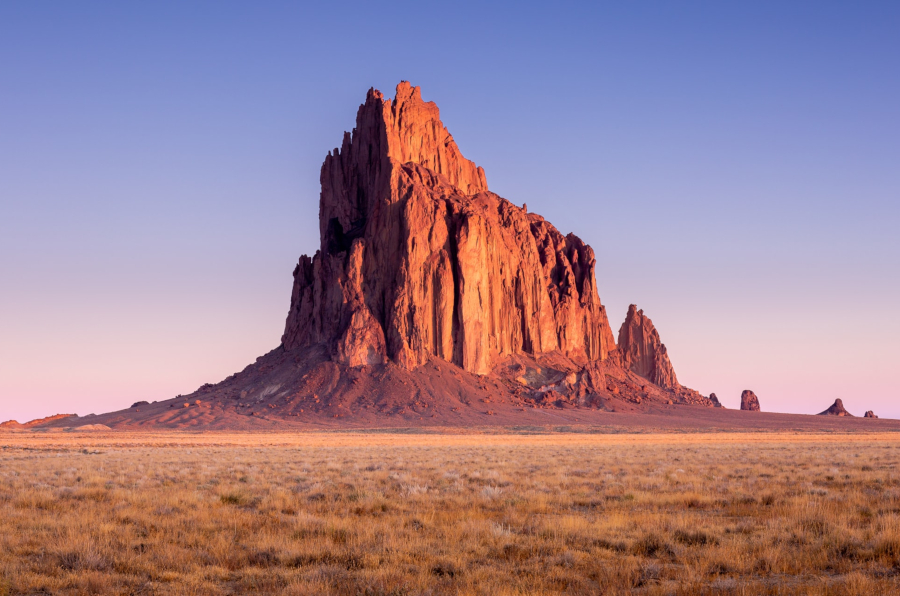
Shiprock is the remnant of a magma plug that formed some 27 million years ago.
The magma intruded under layers of sandstone and shale laid down as sediments in the ancient Western Interior Seaway but never erupted on the surface. It cooled in the throat of the unfulfilled volcano, perhaps 3,000 feet below, and formed the plug.
The magma also followed cracks in rocks, forming seven dikes radiating away from the central formation. Three of these dikes, or volcanic pressure ridges, are dominant, ranging west, northeast, and southeast of the main formation.
What you see today is the root system of a volcano slowly revealed by wind and water erosion over millions of years. Today, Shiprock rises nearly 1,600 feet above the plain and stands 7,177 feet above sea level.
Tsé Bit’ a’í
The Navajo protect Shiprock, which stands on the Navajo Nation. The Navajo call the spire Tsé Bit’ a’í, meaning Rock with Wings, a name they gave it five centuries before Anglos arrived.
Based on oral history, the ancestral Navajo were under siege by an aggressive tribe in the far north. When their medicine men prayed for salvation, the ground beneath them became a huge bird that transported them to the Southwest.
The bird landed at sundown, folding its wings to rest as the Navajo dismounted to explore their new surroundings and the bird turned to stone.
But the Navajo’s troubles were not over. Another story tells of a pair of people-eating Bird Monsters who built a nest on top of Tsé Bit’ a’í and hatched two babies.
Changing Woman, Navajo stories say, sent Monster Slayer, one of her two warrior twins, to kill the dreadful creatures.
After defeating them, he cut off the head of one and threw it as far as he could. It landed more than a hundred miles to the east, where it became Cabezon Peak (geologically, another volcanic neck that erupted around 2 million years ago).
Then, Monster Slayer spared the babies, turning one into the eagle and the other into the owl.